
[태그:] AI agents

  • 5 Ways AI Agents Can Run Your Business While You Sleep

    5 Ways AI Agents Can Run Your Business While You Sleep

    You hired your first employee to take work off your plate. Then you hired more. But at some point, every founder hits the same wall: there are only so many hours in a day, and only so much you can delegate to humans before costs explode.

    That’s exactly the gap AI agents are stepping into in 2026.

    Not chatbots. Not simple automation. We’re talking about systems that can plan, decide, and execute multi-step tasks — on their own — while you’re in a meeting, on a flight, or asleep.

    Here’s what that actually looks like for your business.


    What Makes an AI Agent Different from a Chatbot?

    AI agents for business — comparison of chatbot versus AI agent workflow

    Before diving in, let’s clear up the confusion — because a lot of tools are misusing the word “agent” right now.

    A chatbot answers questions. You ask, it responds. The conversation ends there.

    An AI agent is different: it takes a goal, breaks it into steps, uses available tools, and works toward completing the task with some level of autonomy. A chatbot might explain how to research competitors. An agent will actually collect competitor pages, summarize them, compare pricing, and prepare a report. Labla

    Think of it this way: a chatbot is a very smart search box. An AI agent is closer to a junior employee who can actually do the work.


    Why 2026 Is the Year Business Owners Should Pay Attention

    The numbers are hard to ignore. The AI agent market reached $7.6 billion in 2025 and is projected to grow at 49.6% annually through 2033. DataCamp And it’s not just big enterprises anymore.

    IDC expects AI copilots and agents to be embedded in nearly 80% of enterprise workplace applications by 2026, reshaping how teams work, decide, and execute. Salesmate

    More importantly, the tools are finally accessible. You don’t need a developer on staff to experiment. No-code platforms and pre-built agent workflows are making this realistic for small and mid-sized businesses right now.


    5 Real Ways AI Agents Can Work for Your Business

    1. Customer Support — Without the 9-to-5 Constraint

    AI agents for business — automated customer support running overnight on mobile

    This is probably the fastest ROI for most business owners.

    While chatbots handle basic Q&A, agents can automate the entire support workflow — from the initial inquiry all the way to issuing refunds, updating customer records, and managing orders — without human input on routine cases. Bernard Marr Your human team then focuses on the complex, sensitive tickets that actually need judgment.

    A customer emails at 2am asking about a return. The agent checks the order history, confirms eligibility, initiates the process, and sends a confirmation — all before you wake up.

    2. Lead Generation and Sales Follow-Up

    Here’s a painful truth: most businesses lose deals not because their product is bad, but because follow-up is slow or inconsistent.

    AI agents can autonomously identify leads, qualify them, and schedule follow-ups entirely on their own Mean CEO’s BLOG — based on rules you define once. Respond within 5 minutes, always. Follow up three times, automatically. Move warm leads into your CRM. Flag hot prospects for a human call.

    You set the playbook. The agent runs it, every time, without forgetting.

    3. Marketing That Runs on a Schedule (Not Your Energy)

    AI agents for business — AI drafting scheduled marketing content on laptop

    Content marketing is one of the biggest time drains for founders. Writing, scheduling, repurposing — it never ends.

    Businesses are already deploying content agents that draft social posts and blog articles in the company’s specific brand voice based on weekly themes, alongside data agents that monitor market trends and competitor moves 24/7, delivering insight reports automatically. Gappsgroup

    You review and approve. The agent does the grunt work.

    4. Business Intelligence — Decisions Backed by Data, Not Gut

    An AI agent can analyze market conditions, competitor data, and internal metrics to recommend pricing strategies or expansion opportunities Antier Solutions — the kind of analysis that used to require a consultant or a full data team.

    Imagine getting a weekly summary every Monday morning: here’s how your top 3 competitors changed their messaging this week, here’s what your best-performing product SKU looks like vs. last month, here’s a pricing recommendation based on current market signals.

    That’s not science fiction in 2026. That’s a buildable workflow.

    5. Operations: The Admin Work That Eats Your Week

    Invoices, scheduling, supplier follow-ups, internal reporting — none of it is hard, but all of it takes time.

    AWS has already rolled out AI agents specifically for DevOps and operational tasks Mean CEO’s BLOG, and similar lightweight tools are now available for non-technical business owners. Document processing, contract review flagging, inventory alerts — these are exactly the kinds of structured, repetitive workflows where agents deliver immediate value.


    The One Mistake to Avoid

    The biggest trap business owners fall into is trying to automate everything at once.

    The companies getting real value from AI agents are usually not starting with grand visions. They start with one workflow and expand from there. Labla

    Successful deployments focus on specific, well-defined domains rather than attempting enterprise-wide automation. Deloitte Insights Pick the task that’s most repetitive, most time-consuming, and most clearly defined. Get that working first. Then scale.

    According to PwC, technology delivers only about 20% of an initiative’s value — the other 80% comes from redesigning the workflow around what the agent handles. PwC That means thinking through how work gets done, not just plugging in a tool.


    Where to Start This Week

    You don’t need a massive budget or a technical co-founder to get started. Here’s a practical first step:

    Pick one recurring task in your business that:

    • Happens at least weekly
    • Follows a predictable pattern
    • Currently takes 30+ minutes

    That’s your first agent candidate. Tools like Zapier Agents, Make (Integromat), or n8n let you build simple agent-like workflows without writing code. For more robust setups, platforms like Microsoft Copilot Studio offer enterprise-grade agent deployment.

    In 2026, the question is no longer whether AI agents matter. The real question is which tasks in your work are structured enough, repetitive enough, and valuable enough to hand off first — because that’s where the first serious gains happen. Labla


    The Bottom Line

    AI agents aren’t going to run your entire company. Not yet. But they can handle the predictable, repetitive, time-consuming parts of it — which, if you’re honest, is probably a bigger chunk of your week than you’d like.

    Start small. Pick one workflow. See what it feels like to have that task just… handled.

    Which part of your business would you hand off first? Drop it in the comments — we’d love to hear what’s eating your week.
  • What Is Agentic AI? (And Why Everyone’s Talking About It in 2026)

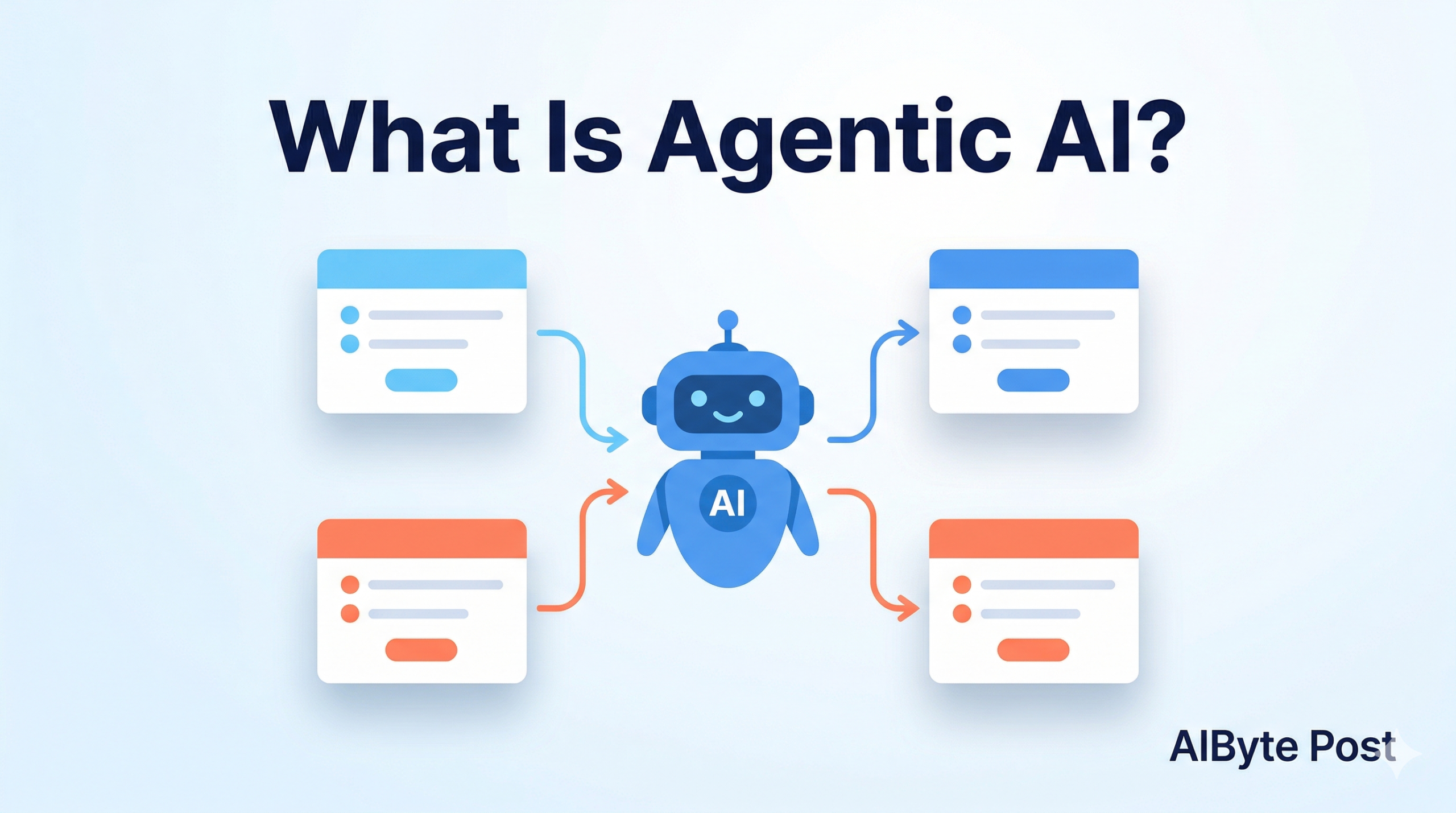
    What Is Agentic AI? (And Why Everyone’s Talking About It in 2026)


    You’ve probably seen the phrase “agentic AI” popping up everywhere lately. Google Cloud just published a major report on it. NVIDIA built an entire open-source toolkit around it. And OpenAI’s latest model, GPT-5.4, was specifically designed to power it.

    But if you’re thinking “I still don’t really know what that means” — you’re not alone.

    This guide cuts through the hype and explains agentic AI in plain English: what it is, how it’s different from regular AI, and why it actually matters for you — whether you’re a curious beginner, a developer, or a business owner.


    So, What Is Agentic AI?

    Let’s start simple.

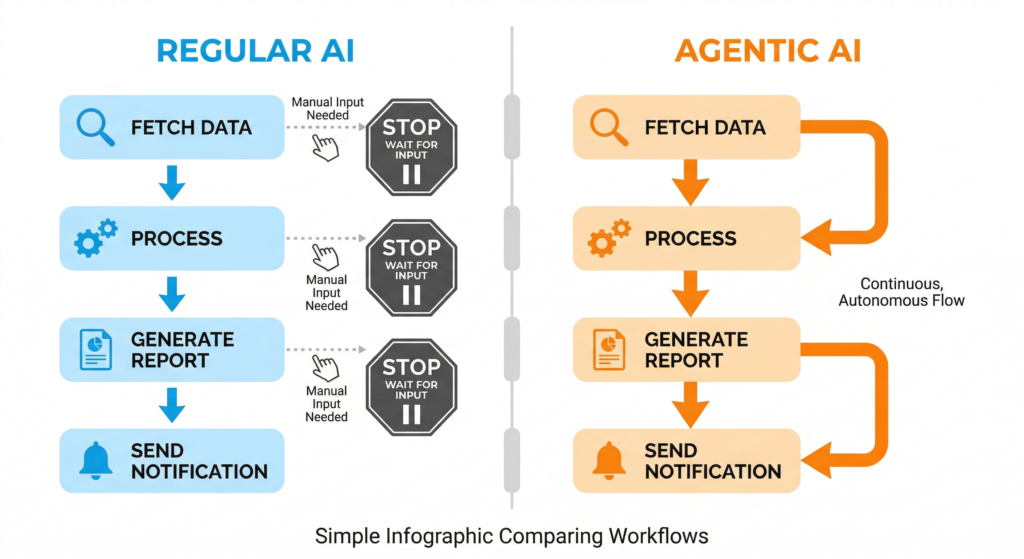
    The AI most people know — like asking ChatGPT a question and getting an answer — is what you could call reactive AI. You prompt it, it responds. It waits for you to do something first, every single time.

    Agentic AI is different. An AI “agent” can take a goal, break it into steps, and then go do those steps on its own — across multiple tools, apps, and environments — without you hand-holding it through each one.

    Think of it like the difference between a calculator and a personal assistant.

    • A calculator waits for you to type in numbers.
    • A personal assistant can say: “I’ll research the options, book the meeting, and send the follow-up email — check back in an hour.”

    Agentic AI is closer to that second one.


    A Simple Real-World Example

    Say you ask an agentic AI: “Research the top 5 competitors in my market, summarise their pricing, and put it in a spreadsheet.”

    A standard chatbot would give you some text. Maybe a list.

    An agentic AI would:

    1. Search the web for competitor data
    2. Visit several websites to pull pricing info
    3. Organise that data
    4. Open (or create) a spreadsheet
    5. Fill it in — and maybe even email it to you

    All of that, with one instruction. That’s the leap we’re talking about.


    Why Is Everyone Talking About It Right Now?

    Agentic AI isn’t brand new as a concept — but 2026 is the year it’s gone from research labs into real products.

    Here’s why the timing matters:

    What ChangedWhy It Matters
    Models got smarter at multi-step reasoningAgents can now plan, not just react
    Context windows expanded (1M tokens in some models)Agents can hold more information while working
    Tool-use APIs maturedAgents can reliably call external apps and services
    Cloud infrastructure scaled upRunning agents at scale is now affordable

    Google Cloud’s 2026 AI Agent Trends Report put it bluntly: “The era of simple prompts is over.” And with NVIDIA’s Agent Toolkit now available to enterprise developers — and adopted by companies like Adobe, SAP, and Salesforce — the building blocks are finally in place.


    What Can Agentic AI Actually Do?

    Here are some of the most common real-world applications right now:

    🔍 Research & Analysis

    An agent can browse the web, read documents, compare data, and produce a summarised report — in the time it takes you to make a coffee.

    💻 Software Development

    Coding agents like those in Cursor or Claude Code can plan a feature, write the code, run tests, fix bugs, and submit a pull request — largely on their own.

    📧 Workflow Automation

    Connect an agent to your email, calendar, and CRM. It can triage messages, schedule meetings, update records, and follow up on leads — all without you clicking through each step.

    🛍️ E-commerce Operations

    Platforms like Picsart now offer AI agent marketplaces where agents can resize images, edit product photos, analyse trends, and optimise your store listings automatically.

    📊 Business Intelligence

    Give an agent access to your data and it can generate weekly reports, flag anomalies, and even recommend actions — not just show you charts.


    Agentic AI vs. Regular AI: A Quick Comparison

    FeatureRegular AI (Chatbot)Agentic AI
    Waits for a prompt✅ Always✅ To start, then works independently
    Executes multi-step tasks
    Uses external tools/apps❌ Rarely✅ Yes
    Makes decisions mid-task
    Can run in the background

    Should You Be Worried About Agentic AI?

    Fair question. When you hear “AI that acts independently,” it’s natural to feel a little uncertain.

    The good news: most agentic AI systems today are designed with what’s called configurable autonomy — meaning you decide how much independence the agent has. You can set it to ask for approval before taking certain actions, or keep humans in the loop at key checkpoints.

    The more realistic concern right now isn’t sci-fi stuff. It’s about accuracy and trust — making sure the agent does the task correctly, doesn’t hallucinate data, and uses the right sources. That’s an active area of development, and it’s why teams at NVIDIA, Google, and Anthropic are all investing heavily in agent safety and reliability.

    As with any tool, the key is understanding what it does well — and where you still want a human to stay in charge.


    How to Get Started With Agentic AI (Even If You’re Non-Technical)

    You don’t need to be a developer to try this. Several tools now give you agentic capabilities through simple interfaces:

    • Notion AI — can now handle research, summarisation, and task automation inside your workspace
    • Zapier’s AI features — connect apps and let AI decide how to route and process tasks
    • ChatGPT (with tools enabled) — can browse, run code, and work across files in a single session
    • Claude (with Projects) — maintains context across long tasks with file and tool access

    If you want to go deeper, tools like Zapier, Notion AI, and Claude are great starting points — no coding required, and you can have your first agent running in under an hour.


    The Bottom Line

    Agentic AI is the shift from AI as a tool you use to AI as a collaborator that works alongside you.

    It’s not perfect yet. It’s not magic. But in 2026, it’s genuinely useful — and getting more capable every month.

    Whether you’re curious about what this means for your job, your business, or just want to stay informed, now is the perfect time to start paying attention to agentic AI.

    Which part of agentic AI are you most curious about — the business side, the technical side, or just how to use it day-to-day? Drop a comment below and let us know!


    Published on AIByte Post — “Cloud AI, Made Simple” | aibytepost.com