
[태그:] cloud AI

  • Who Controls the Chips Controls AI: Inside the 2026 Infrastructure War

    Who Controls the Chips Controls AI: Inside the 2026 Infrastructure War

    You’ve probably noticed the headlines lately. NVIDIA investing billions here. OpenAI shifting its CEO closer to infrastructure. Arm building its own chips. Musk getting into chip manufacturing.

    At first glance, it looks like a bunch of tech billionaires playing an expensive game of Monopoly.

    But here’s the thing — this is the AI race now. And understanding it could change how you think about every AI tool you use.


    It’s No Longer About the Model

    For a couple of years, the big competition in AI was simple: who can build the smartest model? GPT-4 vs Claude vs Gemini — a battle of benchmarks and capabilities.

    That era isn’t over, but it’s no longer the whole story.

    According to IBM’s chief architects, 2026 marks the point where AI models themselves are becoming a commodity. “It’s a buyer’s market,” as one IBM strategist put it — you can pick the model that fits your use case and be off to the races. The model is no longer the main differentiator. IBM

    So if not the model, then what? The answer is boring — and absolutely critical.

    Infrastructure.

    Chips. Power. Data centres. Capital. The physical backbone that makes AI run.


    The Three Fronts of the AI Infrastructure War

    1. The Chip Battle

    Every AI model — whether it’s answering your email or running an autonomous agent — needs chips to process information. Specifically, GPUs (Graphics Processing Units), which are extraordinarily good at the kind of maths AI requires.

    Right now, NVIDIA dominates this space. But that’s starting to change.

    Arm, long known purely as a chip designer rather than a manufacturer, has now unveiled its own AGI CPU built specifically for AI data centres — a major strategic shift. Early customers include Meta, OpenAI, Cloudflare, and Cerebras. Tech Startups

    Meanwhile, Elon Musk is moving into chip manufacturing to secure AI supply, while Micron is ramping spending to meet surging AI memory demand. WBN News

    The takeaway? Everyone wants to control their own silicon. Because whoever controls the chips controls the speed — and the cost — of AI.

    2. The Power Problem

    Here’s something that doesn’t get talked about enough: AI is hungry. Training a frontier model can consume as much electricity as tens of thousands of homes use in a year. Running millions of queries a day isn’t cheap either.

    AI-driven data centre cooling acquisitions are accelerating, next-generation AI chips are entering new development cycles, and large-scale AI factory and power infrastructure deals are emerging globally. WBN News

    This is why you’re seeing AI companies quietly buying up land near power stations, signing long-term energy deals, and even exploring nuclear power. The bottleneck isn’t brains — it’s electricity.

    3. The Capital Race

    None of this comes cheap. And the numbers being thrown around are staggering.

    NVIDIA recently announced a $2 billion investment in Nebius, a full-stack AI cloud company, as part of a strategic partnership to deploy over 5 gigawatts of NVIDIA systems by the end of 2030. NVIDIA Newsroom

    OpenAI has surpassed $25 billion in annualized revenue and is reportedly taking early steps toward a public listing, potentially as soon as late 2026. Rival Anthropic is approaching $19 billion in annualized revenue. Crescendo AI

    These aren’t just big numbers for the sake of it. They reflect a simple reality: building AI infrastructure at scale requires the kind of capital that only the largest players — or those backed by them — can access.


    Why This Matters to You (Even If You’re Not NVIDIA)

    “Okay,” you might be thinking, “this is interesting, but I’m not building data centres. Why should I care?”

    Fair question. Here’s why:

    The tools you use are only as good as the infrastructure behind them. When ChatGPT goes slow, when your cloud AI API hits rate limits, when costs suddenly spike — that’s the infrastructure layer showing through. As competition in this space heats up, you’ll start to see it affect pricing, availability, and which AI products survive.

    The AI you can afford will shift. IDC forecasts that 70% of organisations will prioritise aligning technology investments with measurable business outcomes when considering new AI infrastructure — and by 2028, 75% of enterprise AI workloads will operate on tailor-made hybrid infrastructures. FPT Software Translation: expect more customised, cost-optimised options to emerge as the infrastructure matures.

    The second wave is coming for small businesses. While AI infrastructure is tightening at the top, a second wave of AI tools is beginning to reach small-business operators directly — reshaping how companies compete, hire, and scale. WBN News


    The Big Picture: A Two-Tier AI World?

    Here’s the uncomfortable truth emerging from all this: AI might be splitting into two tiers.

    At the top — the hyperscalers. NVIDIA, Microsoft, Google, Amazon, OpenAI, Anthropic. These companies are locking in chips, power deals, and data centre capacity years in advance. Once locked in, it’s very hard for anyone else to catch up.

    At the bottom — everyone else, using the tools the top tier decides to offer, at the prices they decide to charge.

    As one analysis put it, the competitive edge in 2026 is increasingly tied to who can secure chips, power, and capacity fast enough to keep shipping — making frontier AI as much an industrial-scale operations challenge as a research challenge. Tech Startups

    That’s a significant shift from the early days of AI, when a small team with a good idea could genuinely compete.


    What to Watch in the Next 12 Months

    If you want to stay ahead, keep an eye on these developments:

    What to watchWhy it matters
    NVIDIA’s next chip generationSets the performance ceiling for all AI tools
    OpenAI’s IPO progressWill signal how the market values AI infrastructure
    Energy deals by big techPredicts where AI capacity will grow next
    Open-source model qualityOpen-weight models are now close to top closed models on many benchmarks ByteByteGo — could disrupt the infrastructure lock-in
    Government AI regulationThe U.S. is pushing toward a unified national AI framework, while China’s open-source AI is gaining strategic ground WBN News

    The Bottom Line

    The AI race in 2026 is being won and lost not in research labs, but in power grids, chip fabs, and boardrooms.

    That doesn’t mean smaller players are out of the game. It means the game has new rules — and knowing those rules is the first step to playing smart.

    Whether you’re a developer, a business owner, or just someone who uses AI tools every day, the infrastructure war will quietly shape what’s possible for you. Paying attention now means fewer surprises later.

    Which part of the AI infrastructure story do you find most surprising? Drop a comment below — we’d love to know what you’re watching.


    Want to go deeper? Check out our guide on [AI cloud providers compared] and [how agentic AI is changing workflows in 2026].
  • What Is Agentic AI? (And Why Everyone’s Talking About It in 2026)

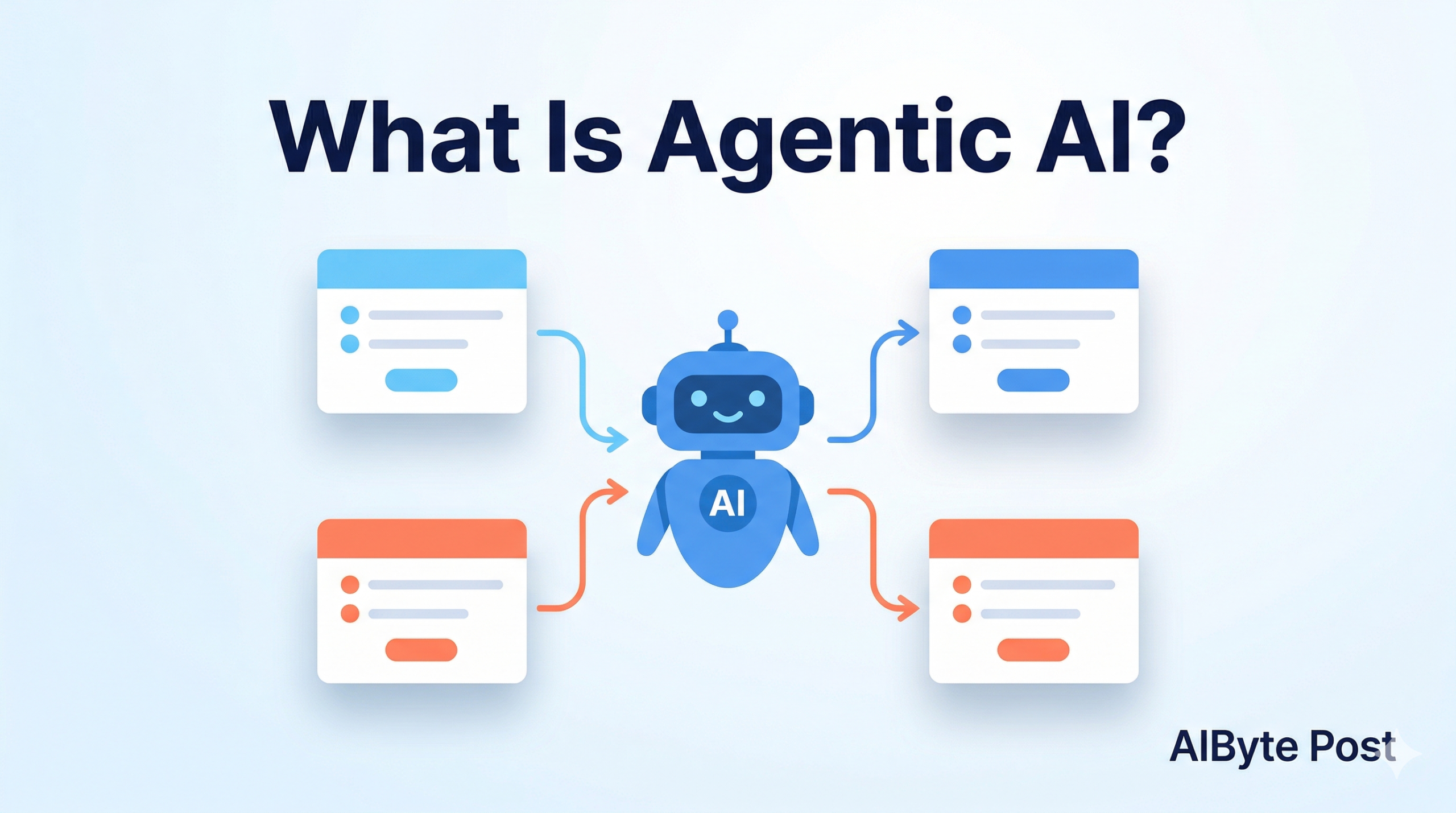
    What Is Agentic AI? (And Why Everyone’s Talking About It in 2026)


    You’ve probably seen the phrase “agentic AI” popping up everywhere lately. Google Cloud just published a major report on it. NVIDIA built an entire open-source toolkit around it. And OpenAI’s latest model, GPT-5.4, was specifically designed to power it.

    But if you’re thinking “I still don’t really know what that means” — you’re not alone.

    This guide cuts through the hype and explains agentic AI in plain English: what it is, how it’s different from regular AI, and why it actually matters for you — whether you’re a curious beginner, a developer, or a business owner.


    So, What Is Agentic AI?

    Let’s start simple.

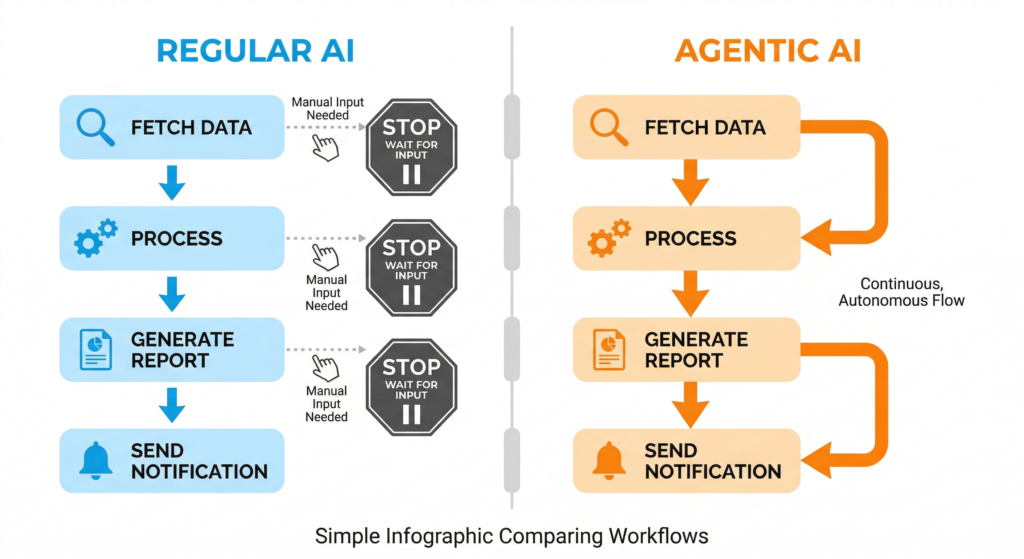
    The AI most people know — like asking ChatGPT a question and getting an answer — is what you could call reactive AI. You prompt it, it responds. It waits for you to do something first, every single time.

    Agentic AI is different. An AI “agent” can take a goal, break it into steps, and then go do those steps on its own — across multiple tools, apps, and environments — without you hand-holding it through each one.

    Think of it like the difference between a calculator and a personal assistant.

    • A calculator waits for you to type in numbers.
    • A personal assistant can say: “I’ll research the options, book the meeting, and send the follow-up email — check back in an hour.”

    Agentic AI is closer to that second one.


    A Simple Real-World Example

    Say you ask an agentic AI: “Research the top 5 competitors in my market, summarise their pricing, and put it in a spreadsheet.”

    A standard chatbot would give you some text. Maybe a list.

    An agentic AI would:

    1. Search the web for competitor data
    2. Visit several websites to pull pricing info
    3. Organise that data
    4. Open (or create) a spreadsheet
    5. Fill it in — and maybe even email it to you

    All of that, with one instruction. That’s the leap we’re talking about.


    Why Is Everyone Talking About It Right Now?

    Agentic AI isn’t brand new as a concept — but 2026 is the year it’s gone from research labs into real products.

    Here’s why the timing matters:

    What ChangedWhy It Matters
    Models got smarter at multi-step reasoningAgents can now plan, not just react
    Context windows expanded (1M tokens in some models)Agents can hold more information while working
    Tool-use APIs maturedAgents can reliably call external apps and services
    Cloud infrastructure scaled upRunning agents at scale is now affordable

    Google Cloud’s 2026 AI Agent Trends Report put it bluntly: “The era of simple prompts is over.” And with NVIDIA’s Agent Toolkit now available to enterprise developers — and adopted by companies like Adobe, SAP, and Salesforce — the building blocks are finally in place.


    What Can Agentic AI Actually Do?

    Here are some of the most common real-world applications right now:

    🔍 Research & Analysis

    An agent can browse the web, read documents, compare data, and produce a summarised report — in the time it takes you to make a coffee.

    💻 Software Development

    Coding agents like those in Cursor or Claude Code can plan a feature, write the code, run tests, fix bugs, and submit a pull request — largely on their own.

    📧 Workflow Automation

    Connect an agent to your email, calendar, and CRM. It can triage messages, schedule meetings, update records, and follow up on leads — all without you clicking through each step.

    🛍️ E-commerce Operations

    Platforms like Picsart now offer AI agent marketplaces where agents can resize images, edit product photos, analyse trends, and optimise your store listings automatically.

    📊 Business Intelligence

    Give an agent access to your data and it can generate weekly reports, flag anomalies, and even recommend actions — not just show you charts.


    Agentic AI vs. Regular AI: A Quick Comparison

    FeatureRegular AI (Chatbot)Agentic AI
    Waits for a prompt✅ Always✅ To start, then works independently
    Executes multi-step tasks
    Uses external tools/apps❌ Rarely✅ Yes
    Makes decisions mid-task
    Can run in the background

    Should You Be Worried About Agentic AI?

    Fair question. When you hear “AI that acts independently,” it’s natural to feel a little uncertain.

    The good news: most agentic AI systems today are designed with what’s called configurable autonomy — meaning you decide how much independence the agent has. You can set it to ask for approval before taking certain actions, or keep humans in the loop at key checkpoints.

    The more realistic concern right now isn’t sci-fi stuff. It’s about accuracy and trust — making sure the agent does the task correctly, doesn’t hallucinate data, and uses the right sources. That’s an active area of development, and it’s why teams at NVIDIA, Google, and Anthropic are all investing heavily in agent safety and reliability.

    As with any tool, the key is understanding what it does well — and where you still want a human to stay in charge.


    How to Get Started With Agentic AI (Even If You’re Non-Technical)

    You don’t need to be a developer to try this. Several tools now give you agentic capabilities through simple interfaces:

    • Notion AI — can now handle research, summarisation, and task automation inside your workspace
    • Zapier’s AI features — connect apps and let AI decide how to route and process tasks
    • ChatGPT (with tools enabled) — can browse, run code, and work across files in a single session
    • Claude (with Projects) — maintains context across long tasks with file and tool access

    If you want to go deeper, tools like Zapier, Notion AI, and Claude are great starting points — no coding required, and you can have your first agent running in under an hour.


    The Bottom Line

    Agentic AI is the shift from AI as a tool you use to AI as a collaborator that works alongside you.

    It’s not perfect yet. It’s not magic. But in 2026, it’s genuinely useful — and getting more capable every month.

    Whether you’re curious about what this means for your job, your business, or just want to stay informed, now is the perfect time to start paying attention to agentic AI.

    Which part of agentic AI are you most curious about — the business side, the technical side, or just how to use it day-to-day? Drop a comment below and let us know!


    Published on AIByte Post — “Cloud AI, Made Simple” | aibytepost.com