
You’ve spent years getting your website to rank on Google. Your traffic is solid. Things feel stable.
Then one day you notice something: people aren’t clicking through to websites the way they used to. They’re asking ChatGPT. They’re using Perplexity. They’re reading the AI-generated answer at the top of Google and moving on — without ever clicking your link.
That’s not a glitch. That’s the new reality of search. And there’s a name for the strategy that helps you stay visible in it: Generative Engine Optimization, or GEO.
What Is Generative Engine Optimization (GEO)?

GEO is the practice of optimizing content to be cited by AI search engines — ChatGPT, Perplexity, Google AI Overviews, Gemini, and Claude. As traditional SEO click-through rates decline and AI systems answer queries directly, GEO is becoming as important as SEO was in the early 2010s. Enrichlabs
Think of it this way: traditional SEO gets you ranked in a list of links. GEO gets you quoted inside the AI’s answer.
When someone asks ChatGPT, Perplexity, or Google’s AI Mode a question about your industry, GEO determines whether your content influences that answer — or whether a competitor’s does. Geoptie
You might also see it called AEO (Answer Engine Optimization), LLMO (Large Language Model Optimization), or AIO (AI Optimization). The terminology varies, but they all describe the same goal: get your content cited by AI. Frase
Why Does GEO Matter in 2026?
The numbers make the case fast.
ChatGPT now serves over 800 million weekly active users. Google’s Gemini app has surpassed 750 million monthly users, with an additional 2 billion encountering Gemini through AI Overviews in Google Search. Perplexity has grown to more than 45 million monthly active users. Coseom
And here’s the critical stat: Gartner predicts traditional search engine volume will drop 25% by 2026, with AI chatbots and virtual agents capturing that share. When AI Overviews are present in Google, organic click-through rates drop by 61%. Geoptie
This isn’t happening in the future. It’s happening now.
Research from GEO firm Brandlight suggests that the overlap between top Google links and AI-cited sources has dropped from 70% to below 20%. LLMrefs In other words: ranking well on Google no longer guarantees you’ll appear in AI answers. They’re increasingly separate games.
GEO vs SEO: What’s the Actual Difference?
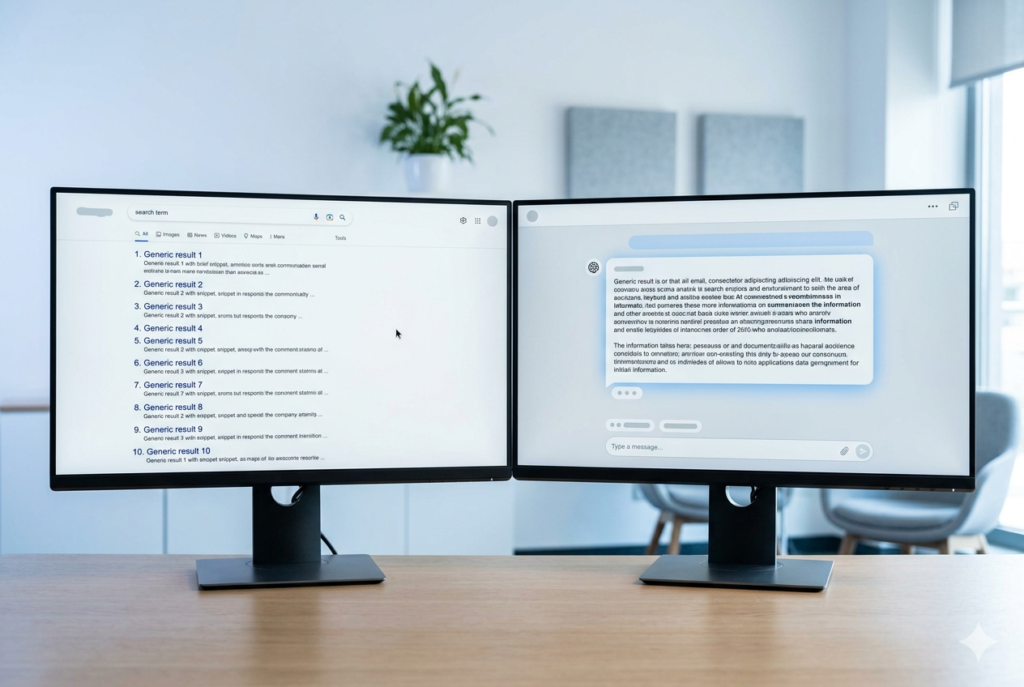
A lot of people ask whether GEO replaces SEO. The short answer is no — it builds on top of it.
| SEO | GEO | |
|---|---|---|
| Goal | Rank in a list of links | Get cited inside an AI answer |
| Who sees you | People who click a result | People who read the AI’s response |
| What wins | Keywords, backlinks, authority | Structure, data, direct answers |
| Traffic type | Click-through to your site | Brand mention + possible click |
If traditional SEO was about earning a spot among 10 blue links, GEO is about earning a place among the two to seven domains large language models typically cite in a single response. The competition is tougher, but the payoff is big: when an AI engine names your brand in its answer, it delivers an implicit endorsement no organic listing ever could. Search Engine Land
The good news is that your existing SEO work isn’t wasted. Strong technical SEO, quality backlinks, and good user experience establish your site as authoritative — and AI engines often use traditional SEO signals as quality indicators. Digital Applied
5 Practical GEO Tactics You Can Start This Week

1. Make sure AI can actually crawl your site
Before anything else, check your robots.txt file — many sites block AI crawlers without realising it. Cloudflare recently changed its default configuration to block AI bots, so if you use Cloudflare, your AI bot traffic may have been shut off automatically. LLMrefs
Look for the ChatGPT-User agent in your server logs to see whether AI systems are visiting you at all.
2. Answer the question in your first 200 words
AI systems that use real-time retrieval — like Perplexity and Google AI Overviews — evaluate a page’s relevance primarily on its opening content. The first 200 words of any article should directly and completely answer the primary query, not build up to it. Enrichlabs
Stop burying the answer. Put it first.
3. Use question-format headings
AI systems pattern-match headers to queries. A header that reads “What Is GEO?” is more likely to be cited for the query “what is generative engine optimization” than a header that reads “GEO Overview”. Reformatting headers as questions that mirror actual search and conversational queries is one of the highest-ROI changes you can make to existing content. Enrichlabs
4. Add data, stats, and expert quotes
According to Princeton research on GEO, the top optimization methods — citing sources, adding statistics, including quotations — can improve AI visibility by 30–40% compared to unoptimised content. Digital Applied
A sentence like “AI-driven campaigns deliver 20–30% higher ROI” gets cited. “AI marketing improves results” does not.
5. Refresh your content regularly
GEO has a unique problem that traditional SEO doesn’t: AI citation decay. Content that ChatGPT cited last month gets replaced by fresher sources this month. Rankings on Google can persist for years. AI visibility shifts in weeks. Frase
Add a visible “Last updated” timestamp and revisit your cornerstone articles every quarter.
How Do You Measure GEO?
This is where most people get stuck — there’s no GEO equivalent of Google Analytics yet.
The most practical approach right now is manual: pick 10–20 questions your audience might ask, run them through ChatGPT, Perplexity, and Google AI Mode, and note whether your brand or content appears. Track this monthly to spot trends.
Measure AI citation frequency — how often your brand appears in AI-generated answers. Platforms like Geoptie now bring audit reports, competitor intelligence, and citation analytics into one dashboard. Search Engine Land
It’s still early, but the brands building this habit now will have a real data advantage in 12 months.
The Bottom Line

GEO isn’t replacing SEO overnight. But the shift is real, it’s measurable, and it’s accelerating.
The question is no longer whether you should invest in GEO — it’s how quickly you can get started. Each month of early action builds citation authority that competitors will struggle to catch up with. Mekaa
The practical starting point is simple: audit one piece of content this week. Check that AI crawlers aren’t blocked, put the answer in the first paragraph, and add a few real statistics. That’s GEO in action — and it’s more achievable than it sounds.
Are you already thinking about GEO for your business? Or is this the first time you’ve heard the term? Let us know in the comments — we read every one.
Want to go deeper? Check out our guide on [What Is Agentic AI? ] and [Who Controls the Chips Controls AI].